
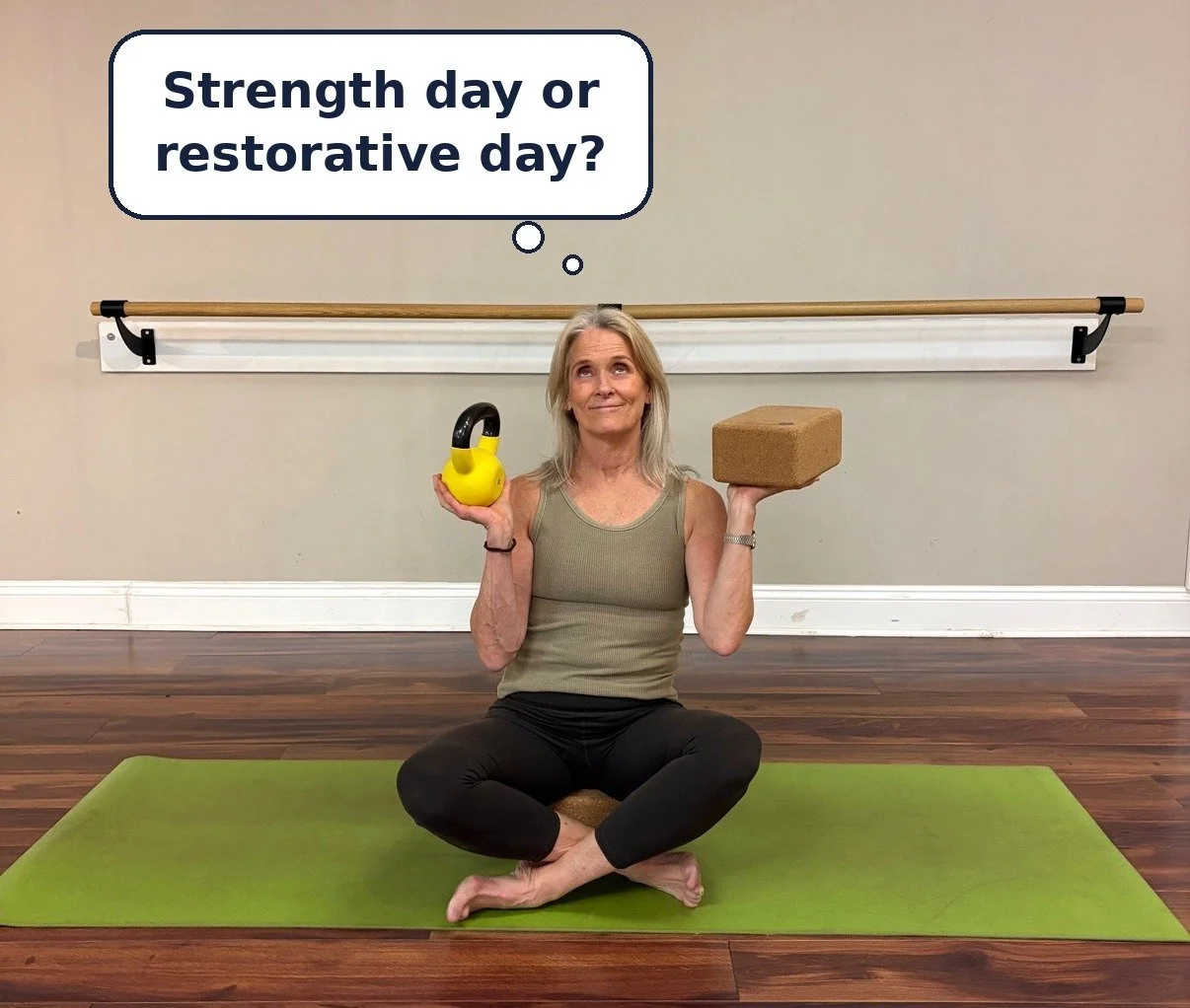
Why strength, mobility, flexibility, and recovery all deserve a place in your exercise routine.
In addition to transforming my diet to an anti-inflammatory one to help manage my arthritic joint pain, which I described in my previous blog, How I Eradicated My Knee Pain and Avoided Surgery with Food, I have recently shifted my focus to creating more harmony in my exercise routine.
For many years, throughout my 30s and 40s, my primary form of exercise was a vigorous style of vinyasa yoga. I believed it covered all the bases: strength, stability, mobility, and flexibility - all in one practice.
When I was younger, that seemed to be enough. But as I got older, I began experiencing lower back pain. Around that same time, I was pursuing my education as a Physical Therapist Assistant (PTA), and I started to recognize something important: my avid yoga practice, without a complementary strength-training program, might not have been serving my body as well as I thought.
I can distinctly remember feeling as though my spinal segments were slipping when I moved into deep twists during yoga class. I had developed a tremendous amount of flexibility, but I began to question whether I had sufficient muscular strength and stability to support that mobility.
As I learned more about anatomy, biomechanics, and the importance of core stability in protecting our joints and spine, I began connecting the dots.
I needed to shift my focus toward strength and stability.
So, what did I do?
In true fashion for me, I went all in!
I directed most of my attention toward strength and stability training, and yoga gradually took a back seat. And guess what? My back pain resolved!
I thought I had it all figured out. Focus on strength and stability, incorporate some active and static stretching, and you're good to go.
Or so I thought.
Fast Forward to Today
Over the past year, I've been struggling with left hip impingement and arthritis, with discomfort that has also been affecting my lower back.
Recent X-rays revealed anterolisthesis and retrolisthesis in my lumbar spine, along with degenerative disc changes and arthritis.
I couldn't help but wonder whether my years of intense yoga, particularly when I was extremely flexible, had contributed to some of these changes. I can't prove that connection, and degenerative spinal changes are common as we age, but it certainly made me reflect on my movement history.
I also began questioning whether my more recent emphasis on strength and stability, while neglecting flexibility, mobility, and adequate recovery, might be contributing to my current symptoms.
I've always had relatively tight hips. But after years of putting yoga on the back burner, my hips felt as though they had become cemented in place!
I wondered whether the loss of mobility and increased muscular tightness around my hips were affecting how my pelvis and femur moved together, potentially aggravating my existing hip impingement.
Again, these are my theories, not proven explanations. Hip impingement can involve structural changes in the bones themselves, and stretching cannot necessarily correct those changes.
But what I did know was that my body wasn't moving the way it used to.
And once again, I needed to experiment.
Finding the Yin and Yang of Movement
I began to realize that I needed to bring more harmony into my exercise routine.
I wanted to continue building strength and stability while restoring some of the mobility and flexibility I had lost.
The truth is, we need all of these components for optimal movement and physical function. They work together, and emphasizing one while neglecting the others can leave gaps in our overall fitness.
But here's something I've noticed over the years, both personally and professionally. We tend to gravitate toward what we love and what comes naturally to us.
Does this sound familiar?
Do you love dance and cardiovascular exercise but avoid strength training?
Are you naturally tight and dislike yoga, so you focus primarily on activities that don't challenge your flexibility?
Or perhaps you're extremely flexible, love yoga, and would much rather spend an hour on your mat than lifting heavy weights?
Sometimes, what we dislike doing is exactly what our bodies need most.
I had experienced both extremes. First, I focused almost exclusively on flexibility through yoga. Then I shifted heavily toward strength and stability.
Neither approach, on its own, was giving my body everything it needed.
Listening to My Body and Making Changes
I decided it was time to make another adjustment.
I began incorporating manual therapy, specifically Active Release Techniques (ART), for my hip and pelvic region with a gifted chiropractor. I also committed to bringing yoga back into my life at least twice a week.
I'm going to be honest with you.
Those first few weeks were difficult!
My body resisted positions and poses that once felt completely natural. I experienced discomfort and stiffness, and the ART sessions weren't exactly relaxing either.
There were moments in yoga class when my inner voice was saying, "Oh God, not that pose!" But I continued, being mindful not to force my body into painful ranges of motion. Gradually, things began to change.
I started noticing a more natural swing through my pelvis when I walked. The uncomfortable, bony end-range sensation in the front of my hip became less noticeable.
My sleep was no longer being disrupted as frequently by hip and back pain, and I wasn't relying on Aleve to get a good night's rest.
I'm even beginning to sit cross-legged again without feeling like it's torture!
Between the manual therapy, yoga, and adjustments to my overall exercise routine, I'm slowly regaining mobility and experiencing improvements in both my hip and lower back symptoms.
This makes sense from a biomechanical perspective. When the hips lack sufficient mobility, the lumbar spine may be asked to compensate during certain movements. Depending on how we move and load our bodies, that compensation can contribute to discomfort.
Our hips, pelvis, and spine don't function independently. They are part of an interconnected movement system.
While I can't reverse the arthritis or structural changes seen on my X-rays, I can work toward improving my mobility, strength, movement mechanics, and symptoms. And hopefully, by managing these factors, I can preserve my function and reduce the likelihood of needing more invasive treatment in the future.
That is an enormous benefit - not just for my hip or back, but for my entire body.
What Does My Exercise Routine Look Like Now?
Today, I'm approaching exercise differently.
Rather than constantly pushing my body through demanding workouts, I'm giving it the variety and recovery it needs.
I alternate strength training and sprint interval days with activities that emphasize mobility, stability, and flexibility.
Some days that means yoga. Other days, it might mean walking, hiking, biking, or simply allowing my body to rest.
And yes, sometimes total rest is exactly what my body needs.
I'm learning that recovery isn't something we squeeze in when we have time. It's an essential component of a well-designed exercise program.
As I continue making these adjustments, I'm gradually feeling more like my former self. I'm also noticing improvements in other areas of my body.
Why? Because the body functions as a system. Nothing works entirely in isolation.
The Takeaway: More Isn't Always Better
If there's one message I hope you take away from my experience, it's this:
Even too much of a good thing can become a problem.
Strength is essential, particularly as we age. But so are mobility, flexibility, stability, and recovery.
It's not about choosing one over the other. It's about understanding how they complement each other - the yin and yang of movement.
I thought I had everything under control until my body started telling me otherwise. And thankfully, I listened.
Bringing More Mobility Into Your Life at MovementRx Studio
If you've been focusing primarily on strength or cardiovascular exercise and feel that your body could benefit from more mobility, flexibility, or mindful movement, we offer several classes at MovementRx Studio that emphasize these components, among others:
• PhyToga Fit
• PhyToga Foundations
• Yoga for Life
• Inner Balance Yoga
• Tai Chi
• Pilates in Motion
We're always happy to help you find the right combination of classes and activities to support your individual needs.
But perhaps the most important lesson I've learned is this:
Listen to your body.
It's always communicating with you. Sometimes subtly, sometimes not so subtly!
Our bodies have an extraordinary capacity to adapt, especially when we provide them with the right combination of movement, appropriate challenges, and recovery.
Be willing to listen. Be willing to experiment. And most importantly, be willing to change your approach when something is no longer serving you.
Your body may be telling you exactly what it needs.