
Strength, Stability, and Balance
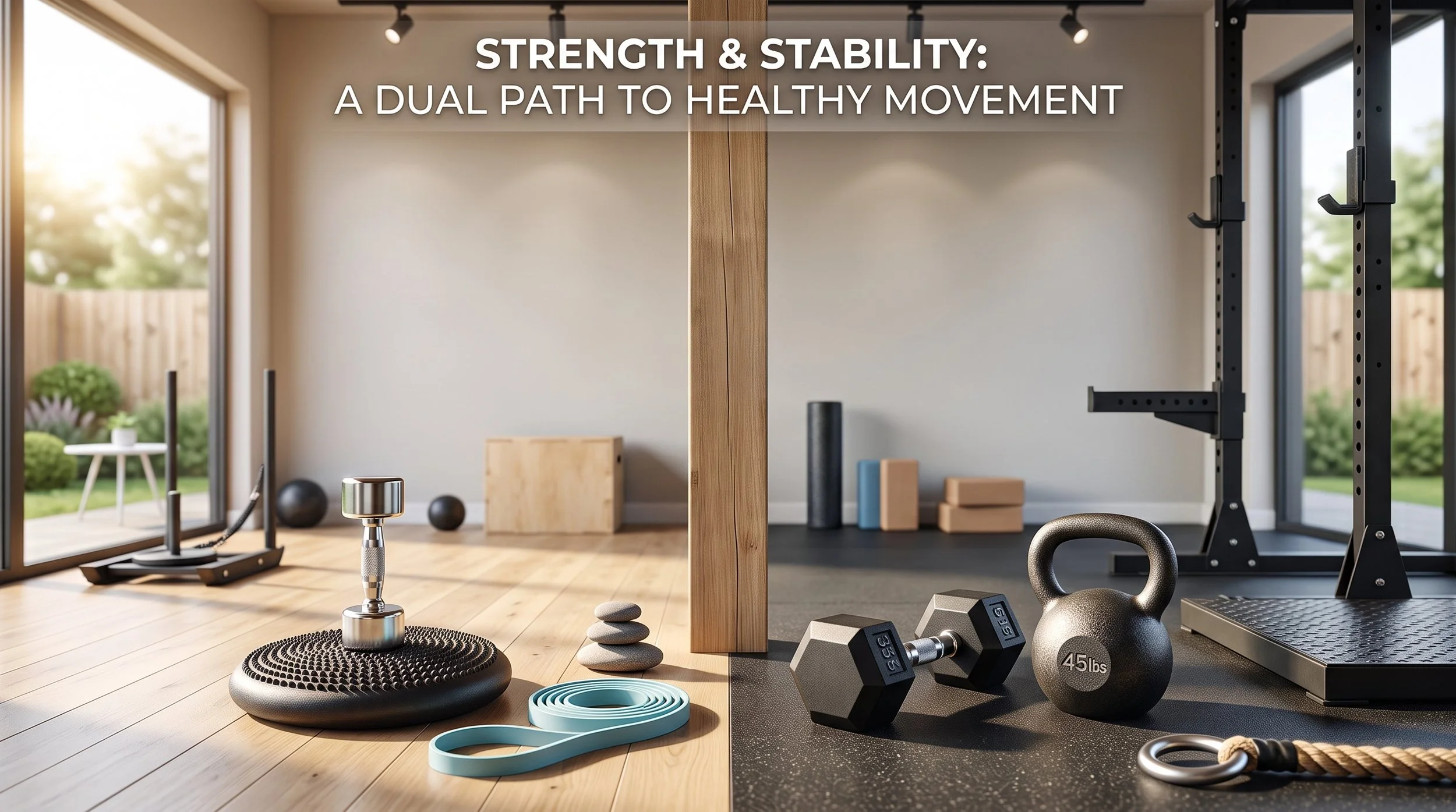
What Is the Difference Between Strength and Stability? And Where Does Balance Fit In?
There is a lot of confusion about the difference between strength and stability, and sometimes the two are even used interchangeably.
The truth is, we need BOTH.
Strength and stability work together to help us move efficiently, perform the activities we love, and reduce our risk of injury. I would never put one above the other - both are critical components of healthy movement.
So, What Is Stability?
Think of stability as your body's ability to control a joint or body segment while you move.
Balance is actually one component of stability. Balance exercises challenge your body's ability to maintain control over your center of mass, but true stability involves much more than simply standing on one leg. It also includes the ability to control your spine, pelvis and joints while your body is moving.
Many of the muscles that contribute to stability are smaller, deeper muscles that you may never have heard of. Instead of creating large, visible movements, they often work behind the scenes to help control movement and keep our joints properly positioned.
The multifidus muscles of the spine are a great example.
These small muscles run along the vertebrae and play an important role in controlling and stabilizing individual segments of the spine. They are part of a coordinated system of trunk muscles that can activate in anticipation of movement.
Imagine preparing to swing a golf club. Before and during that powerful rotation, your nervous system recruits muscles throughout your trunk to help control the spine and pelvis while your hips, torso and shoulders produce the movement.
The multifidus doesn't simply act like a brake that stops you from rotating. Instead, it works with the abdominal muscles and other trunk stabilizers to help maintain appropriate spinal control while movement occurs.
The rotator cuff muscles play a similar role at the shoulder.
When you throw a ball, reach overhead or hit a tennis serve, the rotator cuff helps keep the head of your upper-arm bone centered within the shoulder socket while larger muscles produce the movement. That combination of mobility and stability is what allows the shoulder to move through such an enormous range of motion while remaining controlled.
Here's the problem: many people don't intentionally train this type of control.
These aren't necessarily the 'sexy' muscles like the biceps or rectus abdominis that people immediately think about when they walk into a gym. But they are tremendously important.
Exercises such as dead bugs can help train coordinated trunk and pelvic control, while bird dogs are excellent for challenging the multifidus, spinal extensors, shoulder stabilizers and the entire trunk as a coordinated system.
Balance exercises can also be an important part of stability training - particularly as we age. Standing on one leg, performing a controlled step-up or lunge, or challenging your balance while moving can teach the nervous system and muscles to work together to maintain control.
In other words, stability training - including appropriate balance exercises - teaches your body to control movement before asking it to produce more movement or more force.
Now Let's Talk About Strength
Now we're getting to the 'sexy' muscles - the ones everyone wants to tone and chisel! One of the most common questions I hear is:
“How can I tone my arms?”
OR
“How can I get rid of my belly fat and tone my abs?”
I hear you. We all like having toned muscles.
But there is a MUCH more important reason to build muscle:
QUALITY OF LIFE.
The science is very clear that maintaining strength and muscle becomes increasingly important as we age.
Skeletal muscle doesn't just move our bodies. It is metabolically active tissue and actually functions as an endocrine organ, communicating with other parts of the body through chemical messengers called myokines.
Maintaining muscle and strength is associated with better physical function, greater independence and healthier aging. Resistance training is also associated with a lower risk of all cause mortality, and research continues to uncover relationships between exercise, muscle health, metabolic health and brain health.
And after 50, maintaining that muscle becomes increasingly important.
We gradually lose muscle mass as we age, particularly when we are inactive, and the decline in strength and power can occur even faster than the decline in muscle size.
That means we shouldn't simply accept becoming weaker as a normal consequence of getting older. We need to give our bodies a reason to KEEP that muscle.
And the best way to do that is through progressive resistance training. Train the Big Movers Too
Strength training involves many of the larger muscles you probably have heard of - including the quadriceps, hamstrings, glutes, biceps, triceps, back and chest muscles.
These muscles help us:
Push. Pull. Lift. Squat. Carry. Climb. Run. Get off the floor. Pick up our grandchildren. You get the picture.
The gluteus maximus is a great example. It is one of the largest and most powerful muscles in the human body and plays a major role in hip extension, upright posture and many everyday and athletic movements.
When the glutes are weak or aren't contributing appropriately to a movement, the body may compensate by asking other areas to take on more work.
Exercises such as squats, deadlifts, step-ups, lunges and hip-hinge variations can be terrific ways to build the glutes while simultaneously strengthening other important muscles such as the quadriceps and hamstrings.
And here's another important point:
You have to progressively challenge your muscles.
You don't necessarily need to lift the heaviest weight in the gym, but the resistance does need to be challenging enough to stimulate adaptation. As you become stronger, the exercise needs to progress with you.
Why I Love Functional Strength Training
I am a huge advocate of strengthening the body through movements that translate into real life. We push. We pull. We squat. We lunge. We hinge. We carry. We lift.
Training combinations of muscles to perform these movements can help us maintain the physical abilities we need for everyday life.
There is absolutely a place for isolated exercises and strength-training machines - and sometimes they are exactly what someone needs.
But I also want people to be able to take the strength they develop in the gym and use it in their lives.
Research supports functional exercise as an effective way to improve physical function and the ability to perform everyday activities in older adults. It doesn't have to replace traditional strength training - ideally, the two complement one another.
So Which Do You Need - Strength or Stability?
Think of it this way:
Both.
Stability gives you CONTROL. Strength gives you FORCE.
And balance is one of the ways we see that control expressed in everyday life. And great movement requires both.
A strong body that cannot control its joints well isn't functioning optimally.
A stable body that never develops adequate strength isn't prepared for the increasing physical demands of life either.
Our goal should be to develop a body that is:
Strong. Stable. Mobile. Capable. Resilient.
How Do You Train for Both Strength and Stability?
If you're a beginner - or you haven't exercised consistently in quite some time - I strongly recommend working with a qualified professional who can teach you how to perform these exercises properly and safely.
Classes taught by qualified and experienced instructors can also be an excellent - and FUN - way to train strength, stability and balance.
At MovementRx, we do both.
We work privately with clients and offer customized group instruction designed specifically for adults who want to remain strong, active and independent as they age.
All of our classes incorporate some combination of strength, stability, balance, mobility and flexibility, although certain classes place greater emphasis on one area than another.
Classes With More Emphasis on Stability and Balance
• PhyToga Foundations
• PhyToga Fit
• Yoga For Life
• Inner Balance Yoga
• Tai Chi @ Noon
Classes With More Emphasis on Strength
• Move Strong
• Cardio Core Circuit
• Total Body Fit
• Strong and Fit Express
• Strong and Steady
If you're not sure where to begin, reach out to us at movementrxstudio@gmail.com.
We are happy to help you get started on your journey toward greater strength, stability AND balance.
After all, that's what we do best.
